See https://github.com/RevenueCat/khepri/pull/6798.
This can help debug issues as it helps us cross-reference requests on
our end.

### Changes:
- Logging `X-Request-ID` and `X-Amzn-Trace-ID` headers if present (only
in verbose mode)
- Logging these even for failed requests
- Also logging `request_handled_by_load_shedder` for failed requests
- To accomplish that. `HTTPURLResponse` now conforms to our
`HTTPResponseType`, this allows us to extract headers in an uniform way

### Example:
```
[network] DEBUG: ℹ️ API request completed: GET '/v1/subscribers/$RCAnonymousID%3Ad9dc4f3b33054cf28c0f2ec9da0f48d5' (304)
Request-ID: 'be534c50-5231-403b-be2f-7c077861751d'; Amzn-Trace-ID: 'Root=1-6532c6ca-7ef80f961ec9c4145484df13'
```
This paves the way to add a second set of paths with a separate server
URL to be able to shed requests to offerings and product entitlement
mapping to a separate server.

### Changes:
- New `HTTPRequestPath` with the same properties as `HTTPRequest.Path` +
a new `serverHostURL`
- Moved proxy logic from `SystemInfo`/`HTTPClient` to `HTTPRequestPath`
- Simplified `HTTPRequest` implementation
### Changes:
- `HTTPClient` has a new `X-Post-Params-Hash` request header
- Replaced `HTTPRequest.Method.post`'s `Encodable` value with a more
specific `HTTPRequestBody` (like `HTTPResponseBody`)
- `HTTPRequestBody` allows overriding `contentForSignature` (it defaults
to `[]`) which then `Signing` uses for the hash
- Fixed `LogInOperation` not passing the `VerificationResult` to the
result `CustomerInfo`. This is captured in unit and integration tests
now.
- Add support for signing `POST` requests in `Path.logIn` and
`Path.postReceiptData`

Depends on https://github.com/RevenueCat/khepri/pull/6246
Depends on #2747.

### Changes:
- Changed `Signing` to a `final class`, so it can be instantiated with
the api key.
-  Updated all `SigningTests` to include the correct signatures
Last step of the new Signature format. Follow up to #2679 and #2698.

This reverts the public key change in #2679, since that was the
intermediate key.
This now extracts the new intermediate public key from the signature,
and verifies it using the public key.
### Changes:
- `ETagManager` no longer stores the verification mode
- Created new `VerifiedHTTPResponse`, which has the
`VerificationResult`, extracted from `HTTPResponse`
- Removed `VerificationResult.from(cache:response:)`
- Changed `SignatureVerificationHTTPClientTests` to test using the real
`ETagManager`, so they become more "end to end" unit tests. A lot of
them were relying on implementation details of the mock instead of the
real `ETagManager`.
- Removed several `HTTPClient` tests that were checking a behavior that
was impossible (for example, no verification result despite it being
enabled), or that checked behavior based on the cached
`VerificationResult`
### New format:
 - 32 bytes: intermediate public key
 - 4 bytes: Expiration (in days since epoch)
- 64 bytes: intermediate public key signature, signed with the root
private key
 - 16 bytes: salt
 - 64 bytes: payload signature:
   - salt
   - nonce (if present)
   - request time (as int string)
   - etag (if present)
   - payload

This also adds support for optional nonces for "static" signatures,
which is required for #2667.
Similar to #2486. This will be used for SDK-3181.

```
- WARN: ⚠️ Returning fake signature verification failure for 'GET /v1/subscribers/$RCAnonymousID:fc0508bea4a74a41bfc9a69db30d925f'
- ERROR: 😿‼️ Request failed signature verification. Request to /v1/subscribers/$RCAnonymousID%3Afc0508bea4a74a41bfc9a69db30d925f failed verification
```
This isn't ready quite ready to be released yet. With this change,
`main` can be released once again.

I've added a comment to all the changes so we can easily find them when
ready to be made `public` again.
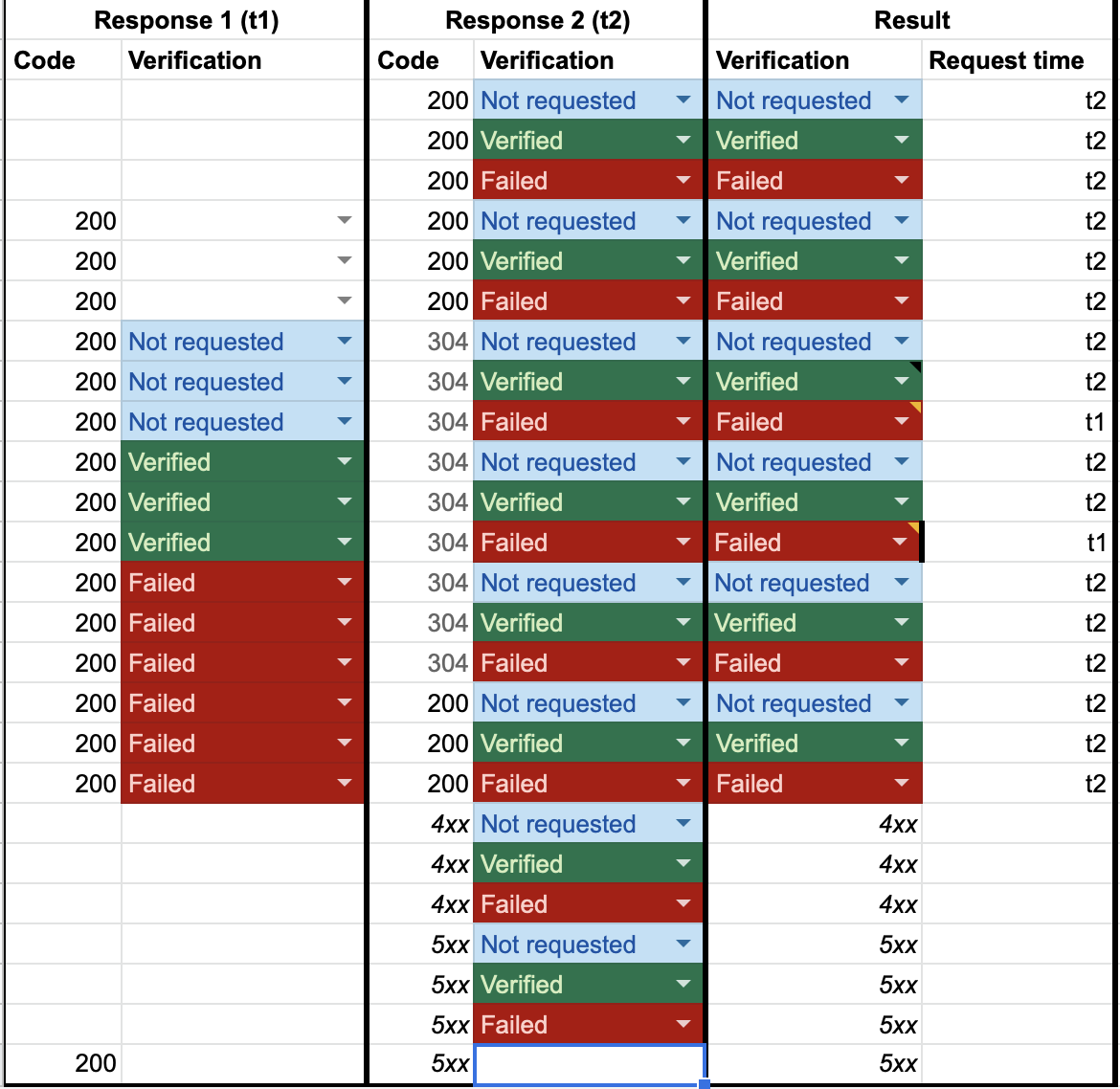
Scenario:
- Response 1: 200 / `VerificationResult.failed`
- Response 2: 304 / `VerificationResult.verified`

Before this change, that was resulting in `VerificationResult.verified`,
even though it was using the unverified response body.
This fixes that so that we don't use the ETag for a response that failed
validation, even in `ResponseVerificationMode.informational`.
Essentially we don't want to modify any behavior on `.informational`
mode. Everything will continue behaving normally, and simply report
verification failures.
Depends on #2326 and #2328.

This allows us to keep all the code, except users won't be able to
configure the SDK with this option.
Note that `Signing.ResponseVerificationMode.enforced` _is_ available, so
we can still test all that behavior, including from integration tests.
Thanks to @aboedo for the suggestion.

### Changes
- Moved signature verification files and tests to new `Security` folder
- Moved `CacheFetchPolicy` inside `Caching`
- Split files inside `Misc` into subfolders
 Facundo Menzella