<!-- Thank you for contributing to Purchases! Before pressing the
"Create Pull Request" button, please provide the following: -->
### Checklist
- [ ] If applicable, unit tests
- [ ] If applicable, create follow-up issues for `purchases-android` and
hybrids
### Motivation
<!-- Why is this change required? What problem does it solve? -->
<!-- Please link to issues following this format: Resolves#999999 -->
### Description
This adds the `backend_error_code` property to diagnostics
`http_request_performed` events.
### Description
This adds a new diagnostics event `http_request_performed` with some
useful information we would like to track about the http requests
performed to our servers.
### Motivation

Allow backend to determine Storefront of customer

### Description

- Adds `X-Storefront` as a default header
- Uses `StoreKit 1` implementation since its not `async`
- `StoreKit 2` implementation is `async` and would require a some
restructuring that we don't need right now

---------

Co-authored-by: NachoSoto <ignaciosoto90@gmail.com>
Fixes#3343.
`SKPaymentTransaction.error` docs say:
> The error property is undefined except when `transactionState` is set
to `SKPaymentTransactionState.failed`. Your application can read the
error property to determine why the transaction failed. For a list of
error constants, see `SKErrorDomain` in StoreKit Constants.
Which is why [`PurchasesOrchestrator` only considered that
domain](https://github.com/RevenueCat/purchases-ios/blob/4.28.1/Sources/Purchasing/Purchases/PurchasesOrchestrator.swift#L792).
This expands this handling to consider any other network error,
therefore providing more precise errors.
Since offline connection error detection was only in `HTTPClient`, I
also moved that out and removed `NetworkError.offlineConnection`, so
that we detect this when converting `NetworkError.networkError` instead.
See https://github.com/RevenueCat/khepri/pull/6798.
This can help debug issues as it helps us cross-reference requests on
our end.

### Changes:
- Logging `X-Request-ID` and `X-Amzn-Trace-ID` headers if present (only
in verbose mode)
- Logging these even for failed requests
- Also logging `request_handled_by_load_shedder` for failed requests
- To accomplish that. `HTTPURLResponse` now conforms to our
`HTTPResponseType`, this allows us to extract headers in an uniform way

### Example:
```
[network] DEBUG: ℹ️ API request completed: GET '/v1/subscribers/$RCAnonymousID%3Ad9dc4f3b33054cf28c0f2ec9da0f48d5' (304)
Request-ID: 'be534c50-5231-403b-be2f-7c077861751d'; Amzn-Trace-ID: 'Root=1-6532c6ca-7ef80f961ec9c4145484df13'
```
This paves the way to add a second set of paths with a separate server
URL to be able to shed requests to offerings and product entitlement
mapping to a separate server.

### Changes:
- New `HTTPRequestPath` with the same properties as `HTTPRequest.Path` +
a new `serverHostURL`
- Moved proxy logic from `SystemInfo`/`HTTPClient` to `HTTPRequestPath`
- Simplified `HTTPRequest` implementation
### Changes:
- `HTTPClient` has a new `X-Post-Params-Hash` request header
- Replaced `HTTPRequest.Method.post`'s `Encodable` value with a more
specific `HTTPRequestBody` (like `HTTPResponseBody`)
- `HTTPRequestBody` allows overriding `contentForSignature` (it defaults
to `[]`) which then `Signing` uses for the hash
- Fixed `LogInOperation` not passing the `VerificationResult` to the
result `CustomerInfo`. This is captured in unit and integration tests
now.
- Add support for signing `POST` requests in `Path.logIn` and
`Path.postReceiptData`

Depends on https://github.com/RevenueCat/khepri/pull/6246
`RevenueCat` took 16 seconds on Xcode 15, now it takes 8 seconds.
### Changes
-
`HTTPClient.testPerformSerialRequestWaitsUntilRequestsAreDoneBeforeStartingNext`
took almost ~1 second because of the artificial delays, now it takes
0.1s
- `FileHandlerTests.testRemoveMultipleLinesOnLineFile` was really slow
(~1 second) because it was appending one line at a time
` DebugViewSwiftUITests` are slow because of the nature of snapshotting
images. I moved them to `StoreKitUnitTests` because that's the slower
suite.

Depends on #2747.

### Changes:
- Changed `Signing` to a `final class`, so it can be instantiated with
the api key.
-  Updated all `SigningTests` to include the correct signatures
### Changes:
- `ETagManager` no longer stores the verification mode
- Created new `VerifiedHTTPResponse`, which has the
`VerificationResult`, extracted from `HTTPResponse`
- Removed `VerificationResult.from(cache:response:)`
- Changed `SignatureVerificationHTTPClientTests` to test using the real
`ETagManager`, so they become more "end to end" unit tests. A lot of
them were relying on implementation details of the mock instead of the
real `ETagManager`.
- Removed several `HTTPClient` tests that were checking a behavior that
was impossible (for example, no verification result despite it being
enabled), or that checked behavior based on the cached
`VerificationResult`
We had lots of different parts of the code doing
`request.url?.absoluteString` and also using different values for
e-tags.
This refactor combines all that to use a single `eTag(for:)` method.

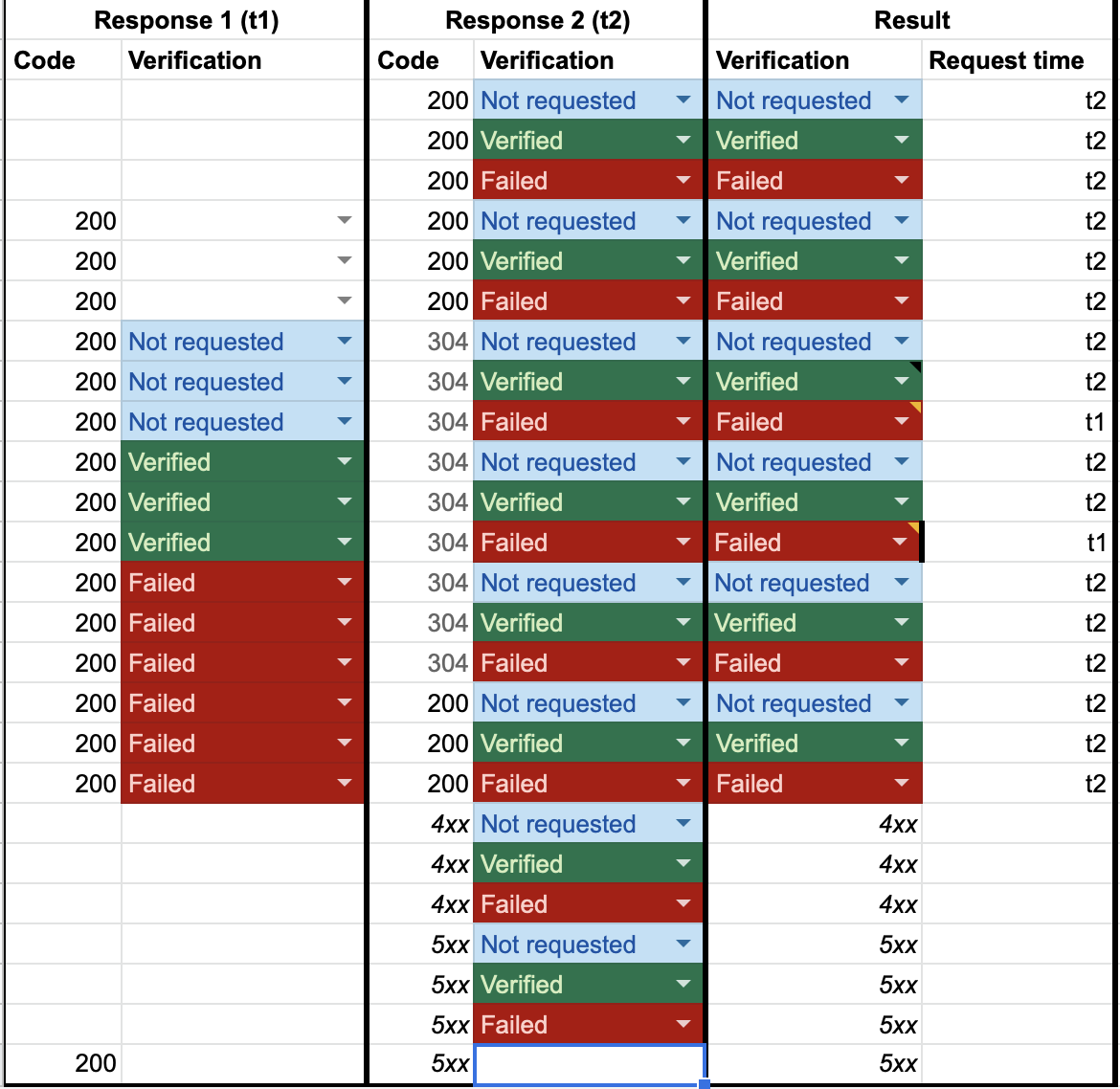
I did this as part of #2665, which is getting closed, but it will still
be useful if we ever decide to change the content of e-tags.
When receiving 500 responses, `HTTPClient` was always calling
`ErrorResponse.from(_ data: Data)`, which tried to decode the content as
if it was JSON.
However, if the response had something completely different, it would
fail to decode.

This wasn't really a bug because `HTTPClient` was still forwarding the
right result, but now it will do so without even trying to parse it.
### Changes:

- Added `Purchases.configureInCustomEntitlementsComputationMode`
- Added `Purchases.switchUser(to:)`
- Disabled parts of the SDK in this new mode
- New example app for testing `customEntitlementsComputation` mode

---------

Co-authored-by: NachoSoto <ignaciosoto90@gmail.com>
This is a follow up to #717.
In order to be able to reproduce #2338, which seems to be an issue only
on `watchOS`, it's important that we now run tests on `watchOS` as well.
We probably won't be able to fully replicate that issue since we don't
run tests on actual devices, so they'll still run on 64 bits. But this
way we might be able to prevent issues that are only reproducible on
`watchOS` in the future.

## Changes:
- Added CircleCI job
- Added lane
- Simplified `UnitTestsHostApp` definition using `SwiftUI`
- Increased _test only_ `watchOS` deployment target to 7.0 (this was
necessary to be able to have a common `@main` for the host app)
- Increased _test only_ `tvOS` deployment target to `14.0` (same as
above, plus we only run tvOS tests on the latest version anyway. We test
backwards compatibility through iOS already)
- Fixed test compilation on `watchOS`
- Disabled `HTTPClient` tests on `watchOS` (see
https://github.com/AliSoftware/OHHTTPStubs/issues/287)
- `StoreKitConfigTestCase` is only available from `watchOS 7.0` since
that's when `SKTestSession` was introduced
- Added `watchOS` support to `UnitTests` target
- Added `watchOS` support to `ReceiptParserTests` target
- Fixed `isFamilySharable` `watchOS` version checks for version 8.0
- Created new `CI-RevenueCat` Test Plan to only run unit tests and not
StoreKit tests on `watchOS`
Essentially we don't want to modify any behavior on `.informational`
mode. Everything will continue behaving normally, and simply report
verification failures.
Depends on #2326 and #2328.

This allows us to keep all the code, except users won't be able to
configure the SDK with this option.
Note that `Signing.ResponseVerificationMode.enforced` _is_ available, so
we can still test all that behavior, including from integration tests.
### Purpose:

This is a prerequisite for #2288. The new grace period means that if we
didn't update the date from the cached responses, entitlements would
become stale and expired after 3 days.

### Changes:
- Added `HTTPResponseBody.copy(with newRequestDate:)` to be able to
modify responses from the header request date
- `CustomerInfo` implements this method to modify its request date
- Added `HTTPResponse.requestDate` to be able to keep track of the
request date from the server
- Added `VerificationResult.from(cache:response:)` to determine the most
restrictive verification result based on what's cached or checked from a
response
- Added `HTTPResponse.copy(with:)` to modify the verification result of
a response using the previous method
- `HTTPClient` now uses the most restrictive verification result
- `HTTPClient` updates request date from server responses or cached
responses (unless verification failed). This was the missing piece for
#2288.

### Tests:
- Verify that `ETagManager` does not use an ETag if verification was
previously not enabled
- Verify that `ETagManager` returns the request date from the server
when returning a cached response
- Verify that `HTTPClient` updates the request date from the server or
from a cached response
- Verify that `HTTPClient` does not update request date if verification
failed
- Tests for `HTTPResponse` request date parsing
- Test for `CustomerInfoResponseHandler` updating request date
- Tests for `CustomerInfo.copy(with newRequestDate:)`


### Other smaller changes:
- Moved `CustomerInfo.asData()` into `Encodable.asJSONEncodedData()`
- Renamed `requestTime` to `requestDate` everywhere for consistency
Instead of manually choosing when to include `nonce` in requests, this
data-driven approach ensures that all requests to endpoints that support
signature verification will make `HTTPClient` do the right thing.

See also #2277 for how `CustomerInfo` and `EntitlementInfo` will use
this.
Fixes [CSDK-629].
Depends on #2274 and #2267.

Entitlement verification is accomplished by preventing MiTM attacks
between the SDK and the RevenueCat server.
With verification enabled, the SDK ensures that the response created by
the server was not modified by a third-party, and the entitlements
received are exactly what was sent.

Entitlements are only verified if enabled using
`Configuration.Builder.with(entitlementVerificationMode:)`, which is
disabled by default.

### Changes:
- Added new `VerificationResult`, which replaces
`HTTPResponseVerificationResult`
- Renamed `Configuration.EntitlementVerificationLevel` to
`Configuration.EntitlementVerificationMode`
- `Configuration.with(entitlementVerificationMode:)` is now `public`
- Added `CustomerInfo.entitlementVerification`
- Added `EntitlementInfos.verification` and
`EntitlementInfo.verification`
- Added tests to cover serialization of these new values
- `CustomerInfoResponseHandler` copies the `ValidationResult` to
`CustomerInfo` (all operations that fetch `CustomerInfo` use this)
- Renamed "validation" to "verification" everywhere for consistency
- Finalized documentation

### TODO:
- [x] Figure out whether to use a separate type from
`HTTPResponseValidationResult` or rename that one
- [x] Figure out final API type and property names
- [x] Add tests for `CustomerInfo.copy(with:)`
- [x] Ensure validation result is encoded and decoded (for caching)
- [x] Add missing snapshots

[CSDK-629]:
https://revenuecats.atlassian.net/browse/CSDK-629?atlOrigin=eyJpIjoiNWRkNTljNzYxNjVmNDY3MDlhMDU5Y2ZhYzA5YTRkZjUiLCJwIjoiZ2l0aHViLWNvbS1KU1cifQ
Fixes [CSDK-634].

## Changes:
- Created `HTTPResponseValidationResult`
- Added `HTTPResponseValidationResult` and `HTTPClient.ResponseHeaders`
to `HTTPResponse`
- Added new `ErrorCode.signatureVerificationFailed`
- Extracted `SigningType` to create `MockSigning` to test `HTTPClient`
without bothering with signatures
- Refactored `ETagManager` to use `HTTPResponse`, making it easier to
pass through response headers and verification results
- Stored `HTTPResponseValidationResult` in `ETagManager` cache
- `HTTPClient` handles signatures from response based on
`SystemInfo.responseVerificationLevel`
- Renamed `HTTPRequest.createIntegrityEnforcedRequestRequest` to
`HTTPRequest.createWithResponseVerification`
- Added lots of tests for this new behavior in `HTTPClient`
- Added lots of new tests for `ETagManager`

[CSDK-634]:
https://revenuecats.atlassian.net/browse/CSDK-634?atlOrigin=eyJpIjoiNWRkNTljNzYxNjVmNDY3MDlhMDU5Y2ZhYzA5YTRkZjUiLCJwIjoiZ2l0aHViLWNvbS1KU1cifQ
This breaks signature validation in #2267 because `PurchasesDiagnostics`
uses that endpoint with and without signature validation, so the first
time it makes a request, it stores the cached response without a
validated signature.

The best solution is to simply not send etags for this endpoint, since
it's used precisely to make sure that requests can be made with no
errors, and we wouldn't want false positives.
 Antonio Pallares